- Documents (on the global tab): a new table,
References, allows you to see which things (i.e. parts, etc) are referencing/using any given Document - When editing a cell, only one editable widget is shown at a time. Scrolling or clicking outside of it leaves its editing mode.
- When
Unique internal PNs(underSettings - Parts) is enabled, parts can be identified by theirInternal PNwhenever importing data (parts, if they exist already, purchase orders and sellables, on suppliers) [fix]Editable widget rendering issue[fix]Chance for context menu items to be incorrectly disabled on the Inventory table[fix]Minimize app button not working- Small UI improvements
- Backport of
v2.10.11andv2.10.12(see changelog) - The Issues table (usually attached to another table, the table it refers to) can now be resized vertically through a splitter
- The app has now a
light themeso you don't have to increase your monitor's brightness during these sunny days. The theme can be switched fromSettings - General - Theme
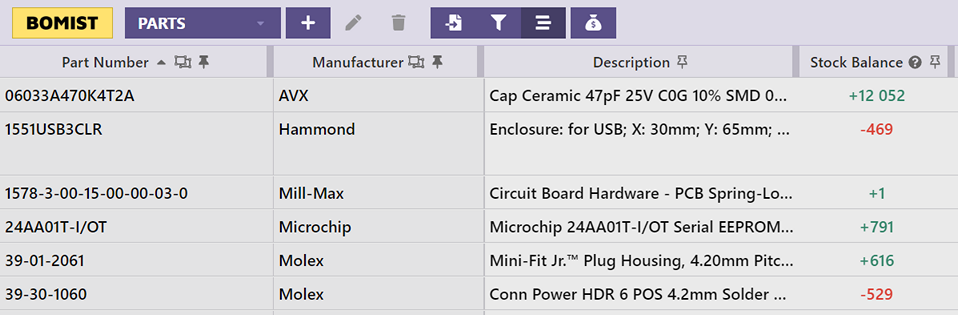
- You can now open new windows for the app so you can see tables from different tabs at the same time, for example, instead of having to go back and forth
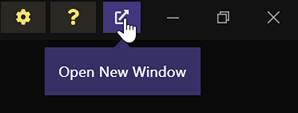
- The app's font size can now be adjusted through
Settings - General - App font size(previously, only the tables font size could be adjusted) - Several small fixes and UI/UX improvements
- Few improvements on the table scroll
[fix]Enterprise: chance for failing to fetch workspaces after successful login
- This release brings a much faster implementation of tables. Being a very table-intensive app, this means the app should also perform better overall.
- Columns in tables can now be pinned (to the left of the table) so they are always visible when scrolling horizontally.
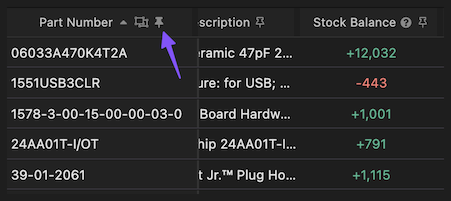
Your current table configurations won't be used with this new implementation. This means all columns will be visible by default and with a default size. For every table make sure to select the View previously being used or to hide columns that you don't need to have displayed. Even though this implementation is much faster, the use of table Views is still recommended.
-
This is the first release that brings support for the upcoming ENTERPRISE plan. Similar to the TEAM plan but it allows you to host everything yourself (users and Team Workspaces), keeping the app 100% offline if needed as it comes with an offline license so it doesn't need to touch our servers at all. The offline license can also include access to multiple Team Workspaces. If you'd like to try this out, please get in touch.
Documentation on how to set up and use the ENTERPRISE plan is available here: enterprise.bomist.com
-
Releases for macOS are now universal (they run natively both on Intel and ARM processors)
[fix]Chance for planned inventory not to be removed and stock not updated after creating production builds
- Backport of
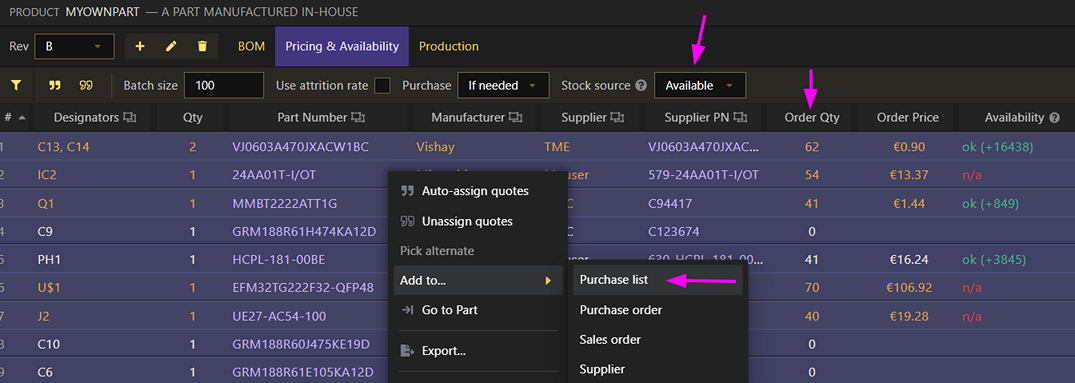
v2.9.26release (see changelog) - Parts can be added into purchase lists from the
Pricing & Availabilitytable and theOrder Qtyis assumed by default - On
Pricing & Availabilitytable, missing inventory can be checked throughStock Balanceinstead ofStock Available
- Some improvements on data sync (Team Workspaces)
- Small UI improvements
[fix]Go-to issue when issue type filter is selected
-
Backport of
v2.9.25release (see changelog) -
Barcode labels (
detailedformat) now include a second barcode which encodes the text that is printed on the label as a title. For example, forPartlabels that represents thePart Number, while forStoragelabels that represents the storage location's name.
-
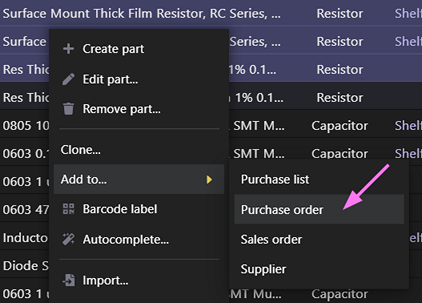
Parts can now be added straight into purchase orders. You can pick an existing purchase order on the desired supplier or create a new one. When adding parts straight into purchase orders you'll have to manually set prices for each line (if needed).
-
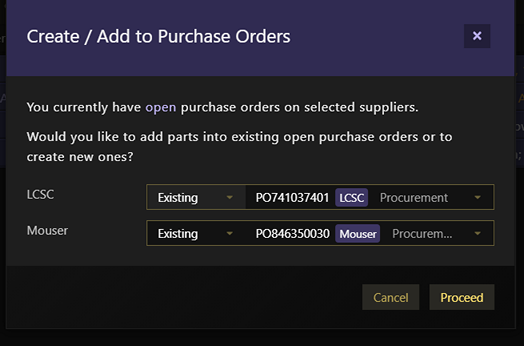
When moving quoted parts on a purchase list to purchase orders, you can now opt to add those into existing open purchase orders or to create new ones. Previously, a new purchase order would be created for every selected supplier.
-
Beta versions of the app now always backup daily and on a different backup folder, so the main one is not clogged with beta backups which could be eventually deleted due to the rolling backups.
-
Procurement settings added under
Settings - Workspace - Procurement
- Backport of
v2.9.24release (see changelog) - Only for sale parts can be added into sales orders and sales-only suppliers
- When manually creating a part, a lot can be created along with the initial inventory
- API:
deliveryDateon sales orders has been deprecated,expected.deliverByshould be used instead (please check API documentation) - Some other small UI and UX improvements